I got to watch Super Bowl XLVI with my Dad this past Sunday. As usual, for me anyway, the game didn't mean much, but listening to Dad's game-play analysis was pretty fun. I'm the ear when he needs an ear. In the past decade, I haven't been able to fool with the Super Bowl all that much. One particular year I missed it was spent beekeeping in this wide beautiful country out west.
 In 2006, February, I was in California; a player in what is considered to be the "super bowl" of beekeeping. As some of you are aware-- the great almond pollination begins about now, and thus the great migration for almost all commercial beekeepers, nearly 1.5 million hives. No, we didn't have our Honeyrun bees out there. In fact, there was no Honeyrun Farm. Jayne and I were newlyweds. She, a grad student at the University of Montana, and I, a peon making a peon's wage, got hooked up with the late great Wayne Morris out of Hamilton, MT.
 Wayne was a second generation commercial beekeeper with around 5000 hives and loads of equipment to move bees. I was lucky enough and dumb enough to be hired on to his crew in August of '05 when Jayne decided she was going to run off to the mountains to finish her masters. Some people, God bless them, get to use their minds to further themselves. Jayne, possessing both beauty and brains, finds herself in this category. On the flip side are people like me and the unsavory workers of commercial beekeeping operations, obliged to set our backs into our wages, encouraged to show up, shut our mouths, and not do a whole lot of thinking.
A bee yard in Bishop, CA
Commercial beekeeping is pretty industrialized. Wayne's operation worked with hives on pallets, big trucks, trailers, forklifts, warehouses, $100,000 extracting facilities, semi trucks to transport bees, enormous holding yards to dock bees, thousands of gallons of HFCS to feed bees, high dollar pollination contracts to make the bees pay, and a witches' brew of chemicals (legal and otherwise) to keep bees alive. My eyes were opened to so many things, good, bad and ugly. August through October was an adventure in Montana beekeeping. November was an adventure in honey extracting. In December and January the adventure was on the road-- transporting 3500 hives from the beautiful high desert valley around Bishop, CA. to the warm avocado laden hillsides of Ventura in southern California.


February brought the almonds-- the super bowl of beekeeping. We (five of us) moved all the hives from the coast to just north of Bakersfield ("the armpit of California"), where Wayne had his bees contracted at $140 per hive on several different almond plantations. 3500 hives... you do the math.

Hold on, little darlings... here comes the food!
I'll spare you the details of actually moving, feeding, medicating and killing hives. Maybe we'll chew on that in another blog post. I'd like to instead share some personal memories of a pollination peon during the great almond pollination; the highlights and lowlights of California '06. You'll surely come to see as I did: commercial beekeeping is not at all romantic or wholesome, especially the pollination part... long nighttime hours, big dusty trucks, and fleabag motels... Here are some snippets of memory in no particular order:
*The continuous blurry stream of truck stop food and truck stop talk, truck stop restrooms and showers, and the good reading on the stalls.
*Wayne's favorite breakfast: Carl's Jr.
His favorite dinner: any "good" salad with a few shreds of lettuce and about a pound of Thousand Island dressing.
*Pulling into the fleabag motels at three in the morning.... they were usually next to the roaring super highway, and the check-in guy, always foreign and oh so welcoming!
*Dropping a pallet of bees (literally, from about six feet up) already lost, one o'clock in the morning in some godforsaken avocado patch.
*Getting lost nightly, even in the high desert (moving bees is all in the dark).
*Driving a loaded bee truck through Los Angeles at two in the morning.
*Becoming well acquainted with Monster, Red Bull, Rock Star, Full Throttle... gag.
*The southern California super highway, Rte 99. One wet night we slowly passed by a wreck... cruiser lights and blood on the road. Wayne's comment: "Ouch... rough night for you!" ...as he downshifted and turned up the radio.
*From an overpass, looking at miles of almond trees, all snow-white in bloom.
*Walking through the almond trees one sunny morning. The bees were out and active. Wayne watched awhile and said, "Well, now I don't feel like a total failure."
*Looking at the vast blue Pacific from a hillside near Ventura. (Wayne! We never did get to go swimming!)
*Multiple trips up to Fresno (even worse then Bakersfield, if that's possible) to fill a thousand gallon tank with HFCS. Dadant provided the goods.
*Wayne getting into a shoving match with one particular fleabag motel owner. The guy woke us up twice, demanding more money. Wayne was never at a loss for racial slurs.
*Taking a run in Fresno and literally being forced to jump over the homeless guys who were sprawled across the sidewalk that morning. Like me, they enjoyed that warm winter weather in the California sun.
*Another run, this time in Bakersfield at six in the morning after Wayne and the boys had retired to the motel. I was shirtless with long hair and a big beard (a Montana Jesus), and I came running toward this scarred up hooded guy gripping a four foot steel pipe. He gave me a wide-eyed glare... but didn't take a swing. Perhaps he was as frightened as I!
*Working through the day, the night, and into the next morning on a 20-hour Salton Sea run. We had moved bees out of the almonds and driven down to place them on the citrus in the far, far south. Wayne wanted to be the only beekeeper in the country making honey in March. I fell asleep watching the Mexicans throw fishing lines in a grapefruit irrigation pond. They wound their line around beer cans as makeshift reels.
*The stark contrast between day and night in the almonds. By day, everything was calm and peaceful-- beautiful white blooms bathing in the California sun. The hum of working bees filling the air.... By night, it was trucks, noise, floodlights, ropes, smoke, yelling and work and work and work...
*Picking a strawberry, an avocado, an orange, lemon, grapefruit and pomegranate all within the span of a few hours. Eating them all.
*The "bathroom trolley" (a wagon with a port-o-john) that served the 20 or so Mexican workers I watched one morning picking strawberries. The field was around 90 acres in size; the berries were ripe. The workers (men, women and children) were all hunched over. I leaned against a shade tree at the side of the field. Then I went behind it and took a pee.
*Midnight runs to the Seven-Eleven. Pints of Haagen-Dazs ice cream. Only the best for the Wayne Morris crew!
*Wayne dropped me off at an L.A. airport one sunny April morning. I was heading back to Montana and from there, home to Ohio in May. I remember saying something like, "Thanks for everything, Wayne. I'll see you next year for the almonds."
Bee help for pollination is hard to find because of the obvious nature of the work, and I knew Wayne wanted me back the following year. It turns out, those were the last few words I ever spoke to Wayne Morris. He met his untimely death the following Fall swimming in the Sea of Cortez. I didn't find out until the winter. The guy I talked to said that he was pulled out in the rip current and drowned. The business was sold the spring of '07.
I'm left with the memories of not quite a year in commercial bees. Again, thanks for everything, Wayne.


 The PEAS Farm greenhouse in the distance, located in the Rattlesnake valley in Missoula.
 At the PEAS farm I learned how to eat beets, celeriac, and kale. Oh, the kale... it grew so large and never got bitter! This was cool weathered Montana, afterall. And the carrots were so so sweet... the best carrots I have ever tasted. We ate them right out of the field without washing them because they were too good to resist. The PEAS farm grew the carrots, and then took them to a cannery at the Montana State Prison where inmates worked to preserve the food, which was eventually distributed by the Montana Food Bank Network. This was just one of the many great programs the PEAS Farm took part in. Below is a picture of some of my fellow workers taking a break while harvesting carrots. So we didn't work too hard all of the time...

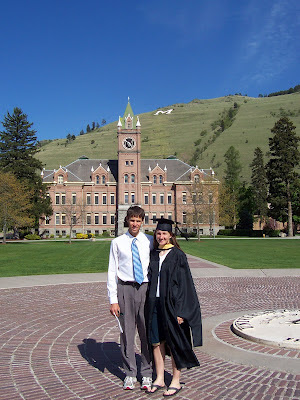 And yes, it is perfectly acceptable to wear flip flops and sneakers to a graduation ceremony in Montana.


