Thursday, January 31, 2013

What Do Bees Do All Winter?

-Posted by Isaac

What do they do when it's cold outside?
Occasionally we get asked this question at the  winter markets.
Do they migrate?
Do they hibernate?


 Last winter, Jim Tew from the OSU bee lab jokingly told a reporter that wintertime bees mostly  "hang out, drink beer and watch TV..."
This left some Columbus Dispatch readers scratching their heads, and poor Mr. Tew was pressed into explaining what he meant by that for several weeks following.
What he was essentially saying is that bees don't do all that much. No hibernating, no migrating, no foraging. In cold wet Ohio, they mostly just try to stay alive.
Every so often we get a day with the temps rising above 50 degrees, and the bees are able to get out and take "cleansing flights." Our 65 degree January day this week was just the ticket.
("Don't go believin that Climate Change crap!")
("Them scientists don't know nuffin!")
Cleansing flights

With the advent of this tropical January craziness, Mason and I got out to check a few hives.

Mason dons the new bee suit
 Here's what bees really do in the winter-- they cluster. They form a tight ball with the queen in the middle and vibrate their wing muscles in order to produce heat. In this cluster, there is a slow rotation of outside bees working their way in, and vice versa. Producing the heat requires fuel, and this is why bees need a hefty store of honey going into winter. As the winter toils on, the bees slowly eat their way upward through the frames of honey.
Loose winter cluster
Here you can see a cluster that has worked its way up to the top. They are eating their stored honey and are almost through with the protein/ honey patty I gave them in the Fall.

If the hive is light weight, and maybe 20% of ours are, we give them a five pound fondant patty to play around with.

A light hive means the bees have eaten their way through most what little winter stores they had. We make many July and August splits (small hives, new queen), so we sometimes run into this food problem. Especially if the bees, for whatever reason, didn't collect much goldenrod and aster nectar.
If you're wondering, the little ball in there helps with the condensation rolling down the sides of the bag instead of falling  directly on the bees.

As I said earlier, the winter is mostly a fight for survival, and as always there are a few casualties.
This is a small hive that died, not from lack of food, but simply because the cluster size was too small to produce enough heat. Without heat the bees are immobile, and they can't move enough to travel the few inches to their stores. I pulled a frame up to show a cross section of the dead cluster. This cluster was only three frames in width. Way too small.
"The Fallen"
February and March are the critical winter months for feeding and checking bees. The queen has been laying, and the brood nest size is increasing. The bees instinctually keep the brood warm above all else... even eating. If we get a two week cold snap it could spell disaster if the bees are not close to a food source. I'm talking inches.
Therefore, in a couple weeks, things get busy. We go around making sure our girls are fat and happy.

Thursday, January 24, 2013

Support Local Restaurants - Support Local Farmers (and Beekeepers!)

-posted by Jayne

We recently began selling our honey to two Columbus restaurants:  Knead Urban Diner, and Barley's Brewing Company.  Naturally, we decided a date was in order to check out how they were using our honey.  We decided to give Knead a try, with our youngest child in tow.  I am happy to say the restaurant is very kid-friendly, while also having an upscale feel to the place.  The great thing about Knead is that they really do work at sourcing as many local ingredients as possible.  So many grocery stores and restaurants out there are just "local-washing" with their advertisements.  Knead is not just "talking the talk" but actually "walking the walk".  Just think how much easier it would be to call up the GFS truck and get everything delivered by one company.  Instead, Knead must contact and work with many small farmers and business owners to source locally grown food.  They also make everything they can from scratch.


I'm not sure why I didn't think to photograph our food when it arrived, but it was really impressive (visit the website to see some pics).  Very large portions, nice presentation, and extremely delicious.  Isaac ordered the famous, "Motherclucker Sandwich" which features "a kiss of local honey."  I got the Cuban, with locally sourced pork and Guggisberg baby Swiss (made in my hometown).  Their french fries and house-made ketchup is worth the extra $3 on the side.  Our baby Bridger concurs.

Knead's map shows where they source their local ingredients.
 Knead was voted best new restaurant by Columbus Monthly and Columbus Underground.  They are also in the running for "Best Burger" in the Columbus Alive "Best of Columbus" dining section.  If you agree that this place is phenomenal, why not cast your vote?  If you've never been to Knead, I highly recommend you give it a try.

Saturday, January 12, 2013

Beeswax Processing

-Posted by Isaac

It's been a tough week for the Barnes clan. All of us except Mommy came down with the flu or a bug of some sort. So Jayne had to play the role of nurse in a house filled with coughing, hacking, spitting, gagging, vomit, urine, tears, crying, moaning, whining, outright screaming and gnashing of teeth...
And, after me, she had three sick kids to tend to. Sometimes I just don't know how she does it.

But now it's Saturday morning, the weather has turned warm and beautiful, Mommy is up at the Worthington Market and I've got the kids. I think we'll go on a picnic to Hargus Lake.
 Before we go, I thought I would get this up -- the long awaited beeswax post. I've had these pictures stored since September, so it's about time. Sometimes we get questions about how the beeswax candles are made, where the wax comes from, if they're pure, etc...
So here you go, in more pictures than words, our wax processing:

The bees have a gland that produces wax, and they have an obvious purpose for it; building of comb. The comb not only serves as their home, a place for larvae, and rearing of young, it also serves as food storage. This is where they put the pollen and honey. When a frame of honey is dried down to around 17%  moisture, the bees will seal it off with a wax capping.
When the honey comes into the honey house, the first job in extraction is to remove this wax capping so that the frames can be spun and the honey will flow out:
Cappings wax
After several weeks of draining, I take the nearly dry wax outside and let the bees eat the little bit of honey they can get to.

 The wax is then put into a melter set at 180 degrees.

The burlap bag serves as an initial filter, straining out dead bees, wood chips from frames, leaves, etc...
Dripping a few minutes
The melted wax is then ladled off the top:

...and poured into forms which will sit and wait for further cleaning:


 After several rounds of this, what comes off the bottom of the melter tank is basically burnt honey. This, we sell as our high priced Christmas blend.
(Kidding!)
Melter honey
 At the end of the season the further cleaning part starts:
Additional filtering
 The wax is remelted (160 degrees), again ladled off the top, and this time run through a 400 micron filter in order to catch some of the smaller pieces of dirt. You can see where the "clean molds" end up, awaiting their fate:
 Candles being the fate for most of the wax. Although a fair amount is just resold in smaller sized blocks to people doing their own craft.
 The larger clean molds are chopped into small pieces then put into a double boiler for the final pour.


 December is a busy time for beeswax candles as everyone seems to want that perfect unique handcrafted gift.
-posted by Isaac

Wednesday, January 2, 2013

Ho Ho Ho

-Posted by Isaac

Ah, January. Time to relax a little. For you and us both... now that the fat-cat retailers and beekeepers have all your money. So hide that credit card and give us a break, will ya?!
As you can imagine, December is a busy time for honey, soap and candles. As stocking stuffers, they stay around a lot longer then Snickers bars, and quite possibly hold a bit more meaning. A thoughtful gift is what I'm saying. The markets were busy as well as the grocery stores.
Anyway, we hope you had a fun and fulfilling break. Here are a few pictures from our wonderful drawn out Christmas:
The tree-- easy for us these last few years. When we moved back to Ohio I planted 50 or 60 of these small pines for a future windbreak. They have yet to pan out as much of a wind stopper, but they're perfect for Christmas. 

Bridger only lost a few fingers on his first go at the chainsaw. Not bad!

Our honey crew is somewhat hit or miss during the holidays, so, needing help, I gave the kids a try at labeling:
As you can see, Mason will make a decent hand in the honey house...
...and Maizy gets a bright shining letter of recommendation sent to our honey competitors.

 Christmas day:
...and look who's first to the tree.
Mason can now be fearless around those bad attitude bees.


The freakish day-after-Christmas snow storm kind of caught us by surprise. I was only about half way done feeding fondant patties to the lighter hives.
It's nice to see snow stay around longer than a day.

But it wasn't so enjoyable on my way up to the last market of the year.
I skidded the honey-laden sleigh right through a fence! Forty minutes of cutting wires from underneath, revving back and forth, wallowing around in the dark put me back up on the road... a little worse for the wear.
Missed the early morning grocery store deliveries, but I still made it to the Worthington Market on time, by God! It was fun telling some of you my about my dashing and daring adventure.
Don't worry, the honey was fine. Although the bodies in the trunk were a bit jostled.

The snow is still around and we're taking full advantage of it.

The kids provide Jayne and I with plenty of exercise.
"Maizy" rhymes with what?
Crown Hill golf course, six miles south of us, is home to thirty-some of our hives. It also has some big, rich sledding hills.
We've had three exciting afternoons on this one. As you might guess, there were a few tears.
No chair lifts? What's up with that?
We hope you had a fantastic break. Thank you for making 2012 an awesome and pivotal year for us. We'll try to avoid that auld lang syne theme and remember our old acquaintances, our valued customers, our business ideals... where we were and where we're going. Thanks for supporting us.
And if I forget your name at some 2013 market, asking again for the third or forth time, please forgive me. I'm an idiot! That's all I can say... not an excuse, just a fact. Don't rub it in!

-Isaac

Sunday, December 23, 2012

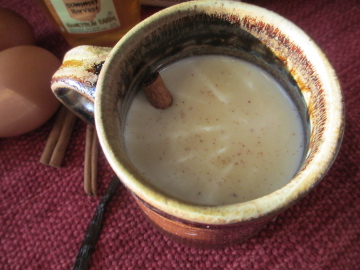
Honey Sweetened Eggnog

We've been enjoying eggnog around here on a daily basis, which proves that you really don't have to be throwing a Holiday party to partake in this wonderful indulgent drink.  I searched all the eggnog cartons at our local Kroger and could not find one that didn't have corn syrup or high fructose corn syrup as an ingredient.  So why not make it ourselves?  We have a plentiful supply of farm fresh eggs, as well as honey, so why not a honey sweetened eggnog?  I found a recipe on pinterest that looked good, and changed the method of cooking the eggs so that I can assure we are safe from Salmonella.  I use a similar method to the one I use when cooking the eggs and milk for homemade ice cream.  Very simple, and great results!  

Here's what you need:

3 cups milk
2 eggs, plus 1 yolk
Pinch of salt
1/4 cup honey (or more if you like it sweeter!)
1 tsp cornstarch
3/4 tsp nutmeg
1/2 tsp vanilla extract

Optional:
Cloves, Vanilla Bean, Cinnamon

Directions:  Whisk together the 2 eggs, plus 1 yolk and the 1 tsp. cornstarch.  In a saucepan, combine 1 and a 1/2 cups of milk with this mixture, heating over medium heat.  Monitor your heat temperature with a thermometer, stirring constantly until it reaches a temp of 160 degrees.  This will destroy any Salmonella bacteria, and will allow the mixture to firmly coat a metal spoon.  

Remove the saucepan from heat and allow to cool, until around 100 degrees.  At this time, add the honey, nutmeg, vanilla extract, and if you would like, add a vanilla bean, cinnamon sticks, cloves, and any other spices you might enjoy.  If you don't have any of those on hand, the nutmeg is really all you need, in my opinion.

Allow the spices to "marry" the rest of the ingredients, then add the rest of the milk (1.5 cups) and your eggnog is ready to enjoy!  It can be enjoyed warm or cold.  We prefer it cold, so I usually place it in the fridge overnight, and the next day it is ready to go.  No alcohol needed for me, but of course you can enjoy it with a bit of rum or bourbon if you like.


Friday, December 21, 2012

DIY: Holiday Ice Lanterns

Making your own Ice Lantern is very easy!  These can be used to hold candles or as a wine bottle cooler for a party.  They make great centerpieces, or lovely adornments for a walkway on a cold winter day.  Here's what you need:

1.  Two containers.  These can be glass containers: one that nests inside the other, or plastic or wax cardboard containers that are left from milk jugs, orange juice cartons, pasta sauce containers, etc.  Just make sure there is at least an inch or more between the two containers as they are nesting.

2.  Greenery or foliage of some sort (boxwoods, fir, or spruce are best), as well as cranberries, mini pinecones, or other bright, decorative materials.

3. Water

4.  Tape, to keep the interior nesting container from floating up and rising.

5.  A freezer

This wine cooler container was made using a milk jug
and a pasta sauce container.  When the glass container
was removed it fit a wine bottle perfectly!

Directions:  
1.  Freeze about an inch of water in the bottom of your exterior container.  This will form the base.
2.  After the base is frozen, place your interior container on top of the ice, and secure it in place with tape.
3.  Add your decorative materials around the sides of the interior container.  Fill the rest of the area between the two containers with water.  Much of the decorative materials will float to the top... this is okay.
4.  Freeze the containers again, usually at least 12 hours until it is set.

Hot water allows the interior container to slide right out.

5.  To remove the interior container after the ice has frozen, remove the tape and fill the interior container with hot water.  This will melt enough of the ice around it to allow it slide out.  I used a glass pasta sauce jar for the wine coolers, and a half pint mason jar for the candle holders.  I also used two pyrex glass baking dishes for a floating candle lantern.  Exterior containers I tried included a square cardboard orange juice container (seen above), a milk jug, and a glass baking dish.  All worked equally well.  


 6.  Remove the exterior container by running hot water over the outside of the dish.  Then find a pretty bowl to set your ice lantern in (so it won't melt all over the place).

Below is the ice lantern I made using the two glass baking dishes.  I can't wait until we have enough snow on the ground to line a walkway with these lanterns.
Using a floating candle ensures the candle will not tip over as the water melts.


And of course I couldn't let this post get by without a shameless plug for some of the floating candles we have for sale in our Etsy shop:

Rustic Floating Star (as seen above)
Set of 12 Small Floating Stars
Floating Flowers with Bee

Have a wonderful Holiday Season!  Merry Christmas from everyone at Honeyrun Farm!
-posted by Jayne

Tuesday, December 11, 2012

CCD, Catching Swarms, Russian Bees, and White Boxes: More Beekeeping Questions Answered

  1. -Posted by Isaac
    Our Candle Pouring Station
    I like to start these dark December days pouring candle wax and listening to the alternative station. Yesterday I heard an awesome song that stuck in my head the rest of the morning.  Some of the lyrics went like this:
    It's better to feel pain   --  than nothing at all...
    The opposite of love   --  is indifference...
    Do you know the one? Well you might. Much to my chagrin I came to find out that my little discovery, a song I planned to learn and try singing for Jayne or whoever, has already gone mainstream. I heard it again last night watching football with Dad. It was background music in a commercial selling baseball gloves or something. Funny how your perspective can change. Maybe I won't learn it now. Oh well, I still I got a day of nostalgia out of that song. 
    We'll try to keep our beekeeping practices from mainstreaming. Size and efficiency in modern beekeeping, as with all modern agriculture, has no doubt brought higher production. But higher production is only a silver lining. There are also big black clouds concerning food production. I'm sure many of our blog readers are well aware of this. Julie Scordato touched on this in her question:


    "Can you give us an update on colony collapse disorder? Is it still bad? Are changing practices helping? Should we still be worried? What have you seen locally regarding this?"
    Colony collapse disorder (CCD) has not been in the headlines as much as it was in 2007 and 2008 but it's still a problem and research into the multitude of various causes has yet to come up with a definitive answer. Some bigger migratory beekeepers claim that keeping their bees away from row crop agriculture (corn, soybeans...) has helped colony health. On our small operation, we do lose bees (15% last winter) we've not seen anything like the CCD symptoms. Mites continue to be our nemesis. And I think this holds for other local beekeepers (those whom I have confidence in, anyway.) There are a few large beekeepers in northern Ohio and I haven't heard much in the way of CCD complaints from them either.

    Andrew Scordato writes:

    "There were lots of swarms this year that Isaac was able to collect. With beekeeping full time, do you have a goal number of hives you want, or is the sky the limit?"

    One of our "swarm catcher" boxes we use in the Spring
  2. I think about this all the time, Andrew. The market for local honey at present seems endless, so we continue to grow with hives and equipment. I'm building enough woodenware to reach a goal of 300 hives this year. We'll decide from there. There's a point where your practices are compromised as well as time with family and other obligations. Right now, I tend to babysit the hives more then I probably need to. We can definitely increase from our present 230. How many more... who knows?
    Little Molly Scordato writes:  "Will you ever consider hybridizing with Russian honeybees for hardiness to weather and parasites? Aren't the russian bees notorious for sussing out and destroying certain hive parasites that the Italian bees tend to tolerate at their own peril?"

    I bought 30 Russian queens a couple years ago and noticed a few things good and bad:

    -The bees don't accept the queen as readily.
    -They don't seem to make as much honey.
    -They seem to weather the winter better, but not at a significantly higher survival rate then the Italians.
    -They don't eat as much honey in the winter, but seem to build up very slow in the spring.

    I need to try a new batch this year. For me, the jury is still out on the Russians, but thanks for the reminder.
  3. Our bees are a healthy mix of Italians, Carniolan, and Russians.
    See the little queen cage in the center?  The bees will eat the candy plug,
    releasing their royal highness. 

    Marci writes, 
    "Why are most bee boxes white?"
    I've wondered this myself. Maybe white reflects light best in the Summer, thus keeping a hive cool. I suspect it has more to do with the cheap and plentiful supply of white paint.
  4. Honeyrun Farm Boxes - a little bit of white, purple, green, gray, and
    whatever color of exterior paint we find on sale at the hardware store.
    Leah asks,
    "How many times can you harvest honey from one hive in a year? I know you have Spring, Summer and Fall honey. But maybe you keep some hives for Spring harvest, some for Fall etc."
    This all depends on weather and location. Of our 21 bee yard locations, only six are close enough to groves of Black Locust trees that we can harvest Spring honey and confidently call it Black Locust honey. If it's a year like 2010 where God smiles down on bees, you can pull honey from a single hive in all three seasons. There was just an abundance of nectar and sunshine. A rainy, cold year like 2011 means you're lucky to have any honey at all. For the most part, you can depend on almost all hives producing a Summer crop with the Spring and Fall honey being kind of hit or miss and having a lot to do with the abundance of nectar producing plants in the vicinity of the yard.

    Spring, Summer, and Fall Honey
  5. Katie asked a question that really got me thinking:
    "What about beekeeping is most rewarding?"

    Happiest after a big honey harvest
    The short answer is pulling honey-- seeing my labor come to fruition, and knowing I don't have to go looking for a "real job" to put food on the table. The deeper answer is my general fascination with bees and their place and our own place in the world. Sounds cliche, huh? If you end up keeping bees you'll notice that you're more in tune with what's going on outside, what's growing, what's blooming, the temperature, the sun, the rain, the wind etc... You'll notice what the farmers are doing, where certain crops are, where tree lines, fence rows, woods, streams and set-aside areas are... what's being sprayed and planted, what's being plowed under, what's being built...
    In general, you become more aware. I like this.
    She also asks,
    "What advice would you offer someone interested in getting started?"
    Prepare yourself for broadening horizons, great high peaks of joy and mystery and reward. Brace yourself for deep valleys of death, depression and worry.
    And join a bee club.  Scioto Valley Beekeepers, our local club, is offering a beekeeping class this coming April, if you feel so inclined.