Monday, March 19, 2012

Spring Comes to Honeyrun Farm

-posted by Jayne

Isaac was wrong in his last post. March IS beautiful in Ohio! Flowering trees are in abundance right now, as are the forsythia, daffodils, even a few tulips have already bloomed. The bees are loving our willow trees- every time I step out our backdoor I hear a buzzing in the sky that sounds like a swarm. It is such a beautiful sound! Willow are a great source of pollen during these early Spring days.
Isaac teaches Maizy about the birds and the bees and the flowering trees...

We have been harvesting lettuce from our greenhouse, as well as a few carrots, both of which I planted back in November. They hardly grew an inch the whole winter, but in the past two weeks they have really taken off. I can't believe how many salads the kids will eat when they are the ones who harvest the lettuce.
We had an amazing hail storm yesterday... like nothing I have ever seen! We even have little dents all over the hood of our car to prove it. Check out the beautiful fog in the background.
Mason was so excited, when he saw the hail littering the ground he asked, "Is that marshmallows?"

Isaac is spending more and more time on his cell phone these days. Getting calls from orchards that need pollination in the coming week. We didn't expect to move bees for pollination until mid-April, but here we are, mid-March, 5 weeks ahead of schedule. Isaac also has to call the land owners that allow us to use their farmland for our apiaries, to let them know he will be arriving in the middle of the night to pick up the hives and move them to the orchards.
We were lucky to host two of our 'regulars' from the North Market farmer's market, Shawn and Joanna, who wanted to come learn more about our bees. They graciously followed Isaac as he instructed them how to secure down the hives so they don't come apart as he transports them to the orchards. They had quite the bumpy, muddy ride, as most of our bee locations are in meadows and pasture land that isn't conducive to traversing in the early Spring, just after it rains.
They snapped a few photos of the mud-covered trailer. For Valentine's Day, I splurged and got Isaac some beekeeping bumper stickers that I created online. In case you can't read through the mud, the top left one is a Honeyrun Farm sticker with our logo, and the bottom right reads, "I'd Rather Be Smoking the Hive" with a picture of a bee smoker.
This one reads, "Don't Hate, Pollinate." I had my "facebook friends" help me come up with catchy beekeeping slogans.
Isaac spent all morning buying every ratchet-strap in the town of Circleville so he can keep the bees safe and secure while transporting hives. Then he spent all afternoon working the bees, checking for large hives that need split to discourage swarming (he reports they are healthy and strong, and already making honey!), and now he is spending his evening-and-in-to-the-morning hours moving hives to transport them for pollination. This beekeeping life can be a bit crazy and hectic in times like this, but the great thing about it is it ebbs and flows, and next week we can relax and know the bees are doing their job to help ensure a good apple harvest in Central Ohio.

Monday, March 12, 2012

March Madness

-posted by Isaac

March is not beautiful (Unless you're in Colorado). Nor is March pleasant (This year is an exception.). But March is still awesome, even here in Ohio, and here's why:
Number one, it's the best time to find arrowheads. Walking aimlessly through tilled fields, staring at the ground, is something I've enjoyed all my life. Easily amused, I know...
The fields have been pounded by rain and snow all winter long, the rocks and flint chips exposed, and artifacts are just waiting there for the picking. Find a 'good field' (top secret!) on a warm sunny day in March and get out there. For us, it always involves jumping fences and crossing streams (trespassing) because the family farm is all no-till. Only conventional tillage turns the ground over so that arrowheads are exposed. Not the best farming practices in my opinion, but it sure makes for good 'head-huntin', as my brother calls it.

There is an old barn adjacent to to the field we were in yesterday, and in one of the walls is a feral bee colony. It has been there for years and I've caught multiple swarms ensuing from this wall. To see them alive and doing well in March was like visiting an old friend.

The kin

A few days previous, another gorgeous warm and sunny one, I made it to yet another favorite field. This time with my cousin Jed. What a day! Six points within an hour. Here they are in Jed's big hand:
If that wasn't exciting enough, I stumbled across something I've never found: a fossil trilobite! It was broken, but still really cool. Here it is on the right:
This is not just any trilobite, but a rare 440 million year old Isotelus trilobite: Ohio's state fossil! Betcha didn't know that. See how educational this blog is.
Jed didn't exactly share my excitement when I picked it up in the field, and later I talked about trilobites to my extended family, getting a few blank stares and a few interesting questions.
"Lemme see those arrowheads again..."

Another reason March is awesome: things are changing. The crocuses bloomed last week, the maples are in bloom now and the willows will soon follow; a warm, glowing yellow cloud streaming down on this little piece of paradise. One of the coolest things is to close your eyes and stand under a willow after it blooms. Sounds like you're in the middle of a beehive.
Here are some ladies hard at work yesterday. You can see the yellow pollen on the right.

When the weather gods look down favorably as they've been doing, March can be a wonderful time for colony build-up. The queen has geared up and the brood nest is expanding daily. Here's a good looking hive on March 9th:
These girls pigged out on the December feeding, the February feeding, and now they're ready for round 3 in March. These patties have a bit higher protein content.  I'll be making splits (dividing some of these big colonies) the first week of April.
Things always look good in the sunshine. I have to remind myself of the date. Four years ago, early March, we drove Mason home from the hospital in a blizzard. It's a long time and a lot can happen between now and April. Even then, we're not in the clear.
The bees are looking great, but the weather could still smash us... like Maizy can smash a pinata.
I crrrush you! I crrrush you like a grrrape!
Cross your fingers and hope for the best...

So March, in its own way, is awesome. The arrowheads are out there, the willows and maples are 'abloom, I wear shorts for the morning run (sometimes), the sauger and crappie are biting at Deercreek... "the times they are a'changing", as Mr. Dylan would say.
And oh yeah, there's even some kind of basketball tournament going on. Borrrrring...

Thursday, March 8, 2012

Super-Chunky Honey Almond Granola

Finally a granola that doesn't crumble to pieces after it is baked! This is a recipe I adapted from the March/April edition of Cooks Illustrated magazine. I was so happy to stumble upon this magazine at my local library (Mt. Sterling library is the best!) I have had trouble finding a granola recipe that I was happy with. Many are simply over-sweetened versions of what is more like a cookie or candy bar, and others were dry and crumbly. This one hit the spot, and the only adjustment I made is substituting honey for the maple syrup/brown sugar they used as a sweetener. An obvious choice in my opinion.While assembling the ingredients, Maizy came along and said, "What's this momma?"
me: "Those are craisins."
Maizy: "Where do craisins live?"
me: "Well, they are like dried up cranberries."
Maizy: "Oh, well, where do cranberries come from?"

For some reason, Maizy has never gone through the "What's that" phase. She went straight to the "Where does that come from?" stage. And these discussions can go on and on and on, as you might guess. But getting back to the recipe...
You will need:
2/3 cup raw honey
4 tsp vanilla extract
1/2 tsp salt
1/2 cup vegetable oil
5 cups old fashioned rolled oats
2 cups raw almonds, chopped course
2 cups raisins or other dried fruit

1. Adjust oven rack to upper middle position and pre-heat to 325 degrees. Line rimmed baking sheet with parchment paper.
2. Chop almonds. I love using this handy little Pampered Chef chopper I got as a Christmas gift. I'm usually not one for kitchen gadgets, but I've spent enough time chopping almonds with a knife to know it is not easy. And the food processor doesn't work because it leaves some almonds too big, while others get pulverized into a fine dust. And a little disclaimer here... I did not let me children use this chopper unattended (and they weren't strong enough to exert enough force to chop them anyways!)
The almonds will look like this once they are chopped. Feel free to allow your stuffed animals to watch as you work (see background).
3. Whisk together the honey, vanilla, and salt in a large bowl. Whisk in oil. Fold in oats and almonds until thoroughly coated.
4. Transfer oat mixture to prepared baking sheet and spread across sheet into thin, even layer (about 3/8 in thick). Using a stiff metal spatula, compress oat mixture until very compact. Bake until lightly browned, about 30 mins, rotating pan once halfway through baking. Do not stir! This keeps the granola in "chunk" form rather than loose and dry. Here is what is looks like when finished.
5. Cool on a wire rack to room temperature, about 1 hour. Break cooled granola into pieces of desired size. Stir in dried fruit. I used a mixture of craisins and raisins, but I also like to use chopped dried apricots, too. Store in an airtight container for up to 2 weeks.
And here is a fun tip from Cook's Illustrated. For better granola... you must have fat. Without the oil, the oats become crisp and dry. When the water in the honey evaporates in the heat of the oven, the sugars left behind develop into a thin coating on the oats and nuts. Without adding fat, the sugar coating becomes brittle and dry. I think next time I'll go all out and try butter. I hope you give this recipe a try!

recipe adapted from Cook's Illustrated

A visit to Curly Girl Farm and the "Sugar Shak"


One of the best aspects of being self-employed is that you can take "mini-vacations" whenever you want (or whenever there isn't immediate work that needs done), and you can even pass them off as educational business trips! I have been trying to convince Isaac that we need to get into maple syrup. We get requests for it at the farm markets from time to time (afterall, maple syrup and honey are both sweet, so we must do both, right?). But because Isaac was always working another full time job, he was convinced there was never time. Maybe now.... February through March is not so busy with the bees, right, Isaac? We have some access to sugar maple trees on the farm where Isaac grew up. To see if this might someday be a possibility, we took a trip to our friend Kristen's farm, Curly Girl Farm, and toured the maple syrup operation where she assists a group of retired men that have a 'sugar shak' near Zanesville, Ohio.
They use cordless drills to tap into the trees, and use plastic spiles and tubing that run right into gallon, two and a half gallon, and five gallon jugs.
Then, they have these great "go-buggies" that they use to haul the sap back to the sugar shak, making the job much easier to transport the heavy jugs.
Here, I had to steal a few photos from Kristen's blog to show what it is like cooking the sap down into syrup. They have three stoves working at a time (and even an extra one in another shed if needed). Sap is boiled, and boiled, and boiled...


...until it goes in this "finishing pan" that will boil it into syrup. The great thing about this operation is that they don't even sell their syrup! They do all this work, just to GIVE IT AWAY! We left with a beautiful pint of fresh maple syrup. Kristen says they all enjoy making the syrup so much, they really don't feel the need to do it for profit. Although Kristen runs a nice little produce stand outside of Zanesville, she simply enjoys working and learning from the group of men who run this 'sugar shak', and she has yet to sell a jar of syrup.
I'm still working on convincing Isaac that this is something we should do... so if you're at a farmer's market and you see him, maybe drop him a request for syrup... ;-).

And in other news unrelated to beekeeping... our son Mason turned 4 this week! Every year I let my kids pick what they want their cake to look like, and this year, he chose a combine cake. It was quite the challenge, but a lot of fun, too. He loved it!


Monday, February 27, 2012

Bread. (As a vehicle for honey)

-posted by Jayne

Today I thought I would share with you our family's favorite bread recipe. In our house, bread is mostly eaten as a "vehicle for honey." Although we do eat our share of sandwiches and like to dip crusty bread in soup, we usually just toast our bread and smother it with butter and honey.
I am proud to say I have not bought a loaf of bread from the store yet this year, as I have simply made bread making a part of my weekly routine. I like to make 2 loaves at a time so I can stick one in the freezer, and have one fresh. This recipe is not the healthiest of all bread recipes since it is made with white flour, but it is super simple and easily can be adjusted with other flours. I have been substituting whole wheat flour and have had good results, although it doesn't rise quite as much. Any expert bread bakers want to lend a hand to tell me what I can do to make it rise better? Please feel free to leave me a comment!

This recipe comes courtesy of my mother-in-law, who clipped it from the recipe section of the Columbus Dispatch.

Easy Crusty Bread
start to finish: 3 hours (20 mins active)
Makes 1 loaf

1 1/2 cups slightly warm water
1/4 cups whole-wheat flour
1 tsp sugar
2 tsp instant yeast
3 cups bread flour
1 tsp salt (original recipe called for 2 but I thought it was too salty)
Cornmeal, for dusting

In a large bowl, combine the water, whole-wheat flour, sugar, yeast, and 1 cup of the bread flour. Stir until smooth. Let stand until doubled in size and bubbly, about 60 minutes.
Add the rest of the flour and the salt and knead in a bowl until smooth. The dough will be very sticky. Cover and let rest for 15 mins. Fold the dough over on itself. Repeat the rest and fold process 5 more times. The dough should become very elastic and stretchy with big bubbles of air. Heat the oven to 400 degrees. Line a baking sheet with parchment paper and dust with cornmeal. (I just give it a generous sprinkling of cornmeal).
Using floured hands, place the dough on the prepared baking sheet. Allow to rest 15 minutes. Spritz the loaf with water, then bake for 25 minutes, or until golden brown and hollow sounding when tapped. Transfer to a rack to cool.

What I love most about this bread is that it is crusty, yet not too dense. In the summer when we are regularly at farmers markets, I often trade honey or soap for bread with Lucky Cat Bakery. Their bread is amazing! When the farmers markets were over in November, I was determined not to go back to the fluffy tasteless store-bought bread, so I began researching bread making by reading Healthy Artisan Bread in 5 minutes a day. This book is very helpful in learning how to make these crusty loaves, rather than traditional bread-pan loaves.

As you can see by the above picture, it is very hard to explain to a 3 year old why they can't eat a piece of bread yet because Mommy has to take a picture for the blog...


Thursday, February 23, 2012

Feeding Bees

-posted by Isaac

Maizy has her tortilla Mardi Gras mask and she's ready to party.

It's a warm week on the bee farm as these February days dwindle away. The girls are out flying, having a good time wasting energy, not finding a darn thing to eat. The temp. reached 55 yesterday and I think they called for near sixty today. This makes for a delightful time if you're a bee-- checking out your new warm world, stretching the wings, sniffing around... but if you're a beekeeper, you're not crazy about it. This was the thought that crept in during my early morning zone-out today.

I like to spend a few minutes 'fire staring' on winter mornings before the wild ruckus begins. When all is quiet and dark, the kids are still sleeping, and there's nothing but the warm, crackling fire for entertainment. Thinking, you ask? ... poetic and philosophic? No, not hardly. Just staring mainly. But I did have one bee thought this morning, and that was this: we could really be screwed. It's too warm! The bees are flying daily and building up a nice brood nest I'm sure. If you live in Georgia, this is a good thing. But not here. Mason and I took the truck to find a load of wood the other day, and we worked in t-shirts. In February!

The reason this may turn out to be a bad thing is that we're looking at March right around the corner... the real killing time for bees. As you beekeepers know, a few days of cold while the bees are trying to raise and keep brood warm can spell disaster. The bees seem to put more importance on keeping the brood (baby bees) warm then feeding themselves. Many hives die of starvation this time of year. Not from lack of available food, but rather a lack of mobility in the hive. They'll sit on the brood and starve with honey stores just two inches away.

I try to remedy this problem by feeding periodically throughout the winter. Although we leave a full super of honey to the bees in the fall, by now they have eaten their way upward to where most hives have a sizable cluster on top. A big food patty on top where the girls can get to it sometimes does just the trick. This winter I tried feeding Dadant sugar patties in January. Most of the hives ate them right up, even with frames of honey right beside the cluster. I came back the first week of this month and plopped down a big cake of my own concoction-- a blend of granulated sugar, powdered protein, and our own honey and pollen.


This is a fairly weak hive pictured, but I like this photo because it gives you a chance to see which patty the bees like better. Proud to say Honeyrun Farm came out the winner. I think it must be the honey blended in there. In most of the hives, the stronger ones, the Dadant patties are all gone.

I'll go back for another round of feeding and checking in March. Hopefully everyone will still be hanging in there. We're sitting at about a 15% winter loss at the moment (Not too bad!), but it all could change with a big blustery cold.

Lent is upon us. "What are you giving up?" Jayne asks.

I told her I would try to give up womanizing, but that would be really hard. I think maybe, for forty days, I'll try to give up worrying about the bees. You can do everything right in this business, have a healthy thriving hive one day, and dead bees the next. Feeding helps, but the weather this time of year is the real factor.

I grew up feeding about 100 head of cattle with my Dad every morning. Then in high school I worked at a jersey dairy, and that was even worse-- blended and rationed feed for every cow twice a day. Bees are so much easier-- a couple feedings a winter and you're done! Of course, cows don't suddenly drop dead either. Lent is tough.

Wednesday, February 15, 2012

My Time Spent at the PEAS Farm in Missoula, MT

(posted by Jayne)

While Isaac was roaming around the western United States working with a commercial beekeeper, I was finishing my masters in Rural Sociology at the University of Montana. As part of my masters program I held an internship at The PEAS (Program in Ecological Agriculture and Society) Farm, which was a partnership with the University's Environmental Studies program and Garden City Harvest, a non-profit that focuses on building community through agriculture.
The PEAS Farm greenhouse in the distance, located in the Rattlesnake valley in Missoula.

The PEAS Farm offered me the opportunity to learn more about growing vegetables on a larger scale than the backyard garden we had growing up. My sister-in-law Becky and I had the crazy dream of becoming produce farmers, but we had never really seen it done in a tangible way, and didn't know if it would really be possible to make a living this way. The PEAS farm showed us a reasonable scale that could be achieved, and put us in contact with an inspiring professor and farmer, Josh Slotnick. Josh and his wife founded Clark Fork Organics in 1992, and in 1996 he became an Environmental Studies professor at UM and helped to start the PEAS farm.
One of the best parts about working at the PEAS farm was that while we worked in the fields - planting, weeding, watering, and harvesting... Josh would teach. Josh has the gift that so many professors have - being able to explain obscure concepts in such an easily understandable, attainable way. Michael Pollan, Wendell Berry, and Jared Diamond were just a few of the authors often discussed, intermixed with information about crop science, organic farming practices, as well as practical knowledge about how to cook rare vegetables.
At the PEAS farm I learned how to eat beets, celeriac, and kale. Oh, the kale... it grew so large and never got bitter! This was cool weathered Montana, afterall. And the carrots were so so sweet... the best carrots I have ever tasted. We ate them right out of the field without washing them because they were too good to resist. The PEAS farm grew the carrots, and then took them to a cannery at the Montana State Prison where inmates worked to preserve the food, which was eventually distributed by the Montana Food Bank Network. This was just one of the many great programs the PEAS Farm took part in. Below is a picture of some of my fellow workers taking a break while harvesting carrots. So we didn't work too hard all of the time...
The PEAS Farm had such a profound effect on my life, and I credit my time there for giving me the faith to jump into this Honeyrun Farm project once we returned to Ohio. I still remember clearly a time during my final Fall semester at UM, working at the farm one afternoon, we finished early with our harvesting for the day. We had harvested a pumpkin that was well known for having great seeds for roasting, and we retired to the PEAS Straw Bale Barn to try them out. I was standing on the porch of the barn, looking out over the Rattlesnake Valley, the trees blanketed in brilliant colors of Fall, the soft green mountains surrounding us on all sides, and said to Josh and my fellow workers, "After I leave here, when I think back on my time spent in Montana... this is what I am going to remember the most."
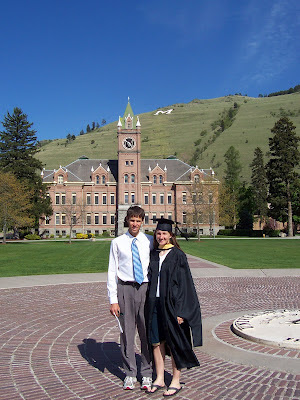
And I was right. Not just the beauty of the area, but everything about the PEAS farm resonates with me as being the right place for me at that point in time. I'm so glad I had the opportunity to work at the PEAS farm, and only hope there could be more programs out there similar to Garden City Harvest in Missoula, MT. Thank-you Josh, for encouraging a new generation of farmers.

And yes, it is perfectly acceptable to wear flip flops and sneakers to a graduation ceremony in Montana.