Friday, September 21, 2012

Not Just Another Color in the Crayola Box.

-posted by Jayne
My first recollection of the word "goldenrod" was describing a crayon.  It was always just another muted yellow in the crayon box.  Kind of a dull mustard color.  It wasn't until much later that I realized, the crayon color is describing a flower.  
So I dug out our crayon box and took a look.  Yep.. it's still there.  Still the same color.  But I'm not sure the color accurately depicts the actual flower.  The color changes as the season progresses.  It starts off as a dark greenish-yellow, then ripens to a vibrant bright yellow (seen below in the bright mid-day sun).
As the flower matures, it becomes the deep yellow color you see below, more like the actual color of the crayon.  Depending on the time of day, and how the sun is hitting it, the color of the flower can change drastically.  
This week we took the kids out for an evening hike, for the sole purpose of checking out the goldenrod.  I wanted to see what kind of pictures I could get as the sun was setting.
 I didn't do anything to these photos... no adjusting for color or anything.  This is what goldenrod really looks like when the sun is setting over the horizon, lighting up the flowers in such a beautiful way!


 The tiny white flowers you see interspersed with the goldenrod below are asters.  These are the next big nectar source for the bees.  They are just beginning to open.  Perfect timing.  Fall honey, primarily from goldenrod and asters, is deeply robust, with tones of butterscotch and mint.  I have been eating more Fall honey than anything else this year.  It has really grown on me!
As we approached the bee yard surrounded by this field of goldenrod... the smell was there.  While the bees are ripening the goldenrod nectar, it has a distinctly strong smell.  Some people think it smells like dirty laundry.  But I commented to Isaac... I don't really smell that anymore.  To me, it just smells like Fall honey.  And it smells pretty good.    Have a good weekend!

Thursday, September 13, 2012

A Good Week

-Posted by Isaac

The Lithopolis Honeyfest was a resounding success for all involved. We began setting up in the rain and wind, gave up, took a long coffee break, and finished about 10:30 when the skies cleared and the crowd slowly trickled in. I snapped a couple photos before the tidal wave of honey lovers barreled in around noon.


Jayne was the mastermind behind this four-sided display


This year we had our new iphones which enabled us to swipe charge cards. Very handy... except for the few honey stick purchases for $1.00 that people wanted to charge... that was a bit tedious.


The next day we rewarded ourselves with trip to Cincinnati. Mason, Grandpa and I caught a Reds game and found a few flying pigs to climb on.


The goldenrod is in full bloom and the bees are working hard on these gorgeous sunny days. Soon the bee yards will smell like dirty laundry as the bees dry down the nectar.  (Goldenrod is notorious for smelling like dirty laundry when it is in the hives.)


Maizy and I took a pollen run yesterday and discovered that the farmers are already in full swing with the corn. What an early year!

The goldenrod pollen is a bright orange and has a sweeter taste then the yellow ragweed pollen we've collected recently.  
Maizy had the obligatory pollen snack.

Maizy chose to wear her "cowboy-girl boots" for the pollen run.

And of course a bouquet for Mommy was in order.

Friday, September 7, 2012

Honeyfest Prep / Fall Prep


-Posted by Isaac

We've been bottling like crazy this last week for the Honeyfest. If you're coming out to Lithopolis this Saturday, we'll see you there. Hopefully it's not a wash-out. Most years, the rain seems to threaten but never quite materializes. If it does rain... oh well... just hang out under our tent. We're bringing two this year. 
We'll have all the usual available: 
Spring, Summer, Fall Honey, Lavender and Lemon Verbena infused, Naturally Granulated, Comb Honey, Chunk Honey, Bee Pollen, Handcrafted Soap...


Plus something special:
Introducing Tulip Poplar honey...

This is honey that came from a few bee yards south of here near the Hocking Hills where tulip poplar trees abound. When I extracted the supers coming out of those yards (early July), I was surprised to see the honey was black and tasted completely different. A dark smokey flavor that lingers heavy on the palate.  I separated these buckets of honey from the rest, and we've been waiting on labels so we could sell  it as another varietal honey. Well, they came in a couple weeks ago, and what better place to introduce it then the Honeyfest!
We live in a wonderful area of the state. You can have such completely different honeys produced just twenty or thirty miles apart.

In other news...
Between the morning and evening bottling sessions, I've been working on Fall prep for the hives. That involves taking a yard that looks like this:


And making it look this this:

Basically I'm taking supers off, getting the hives ready to collect goldenrod and aster honey with a single box on top. The goldenrod flow just isn't big enough to pile supers on as we did with the summer honey. Some of the weaker hives will need every bit of it just to get beefed up for winter.
Between removing boxes, I check the brood pattern, put Hop Guard mite strips in, feed the weaker hives (sugar water and Honey-B-Healthy) and one other thing-- drench the bees with this stuff called Nozevit.

Jim North (our spry 76 year old neighboring beekeeper) says he's seen real improvement health-wise with his bees. When it comes to knowing bees, I trust Jim's judgement more then anyone. Nozevit is a natural plant polyphenol food supplement. It's supposed to improve the bees' intestinal track and help with digestion.  We'll give it a try this year.


The goldenrod has just started to turn yellow and the bees will soon be busy again after several weeks of nothing to do. What an awesome time of year this is! Warm, sunny and colorful. We've had some recent rain (thanks to my own hurricane) so maybe that will increase the nectar flow from these beautiful Fall flowers.
Here's hoping.
See you at the Honeyfest!

Thursday, August 30, 2012

Bee Pollen - the Intricacies and Health Benefits of this Superfood

-posted by Jayne

So you want to know more about bee pollen?   We received some questions from one of our faithful blog followers (thanks Marfa!) and also get many questions from our farm market customers about bee pollen.  What is it?  What do you do with it?  How do you harvest it?  How does it get in that little granule form?  

All great questions.  I will attempt to answer them here.

Pollen can be eaten fresh, put in smoothies, on cereal, in yogurt, mixed with honey,  and more.
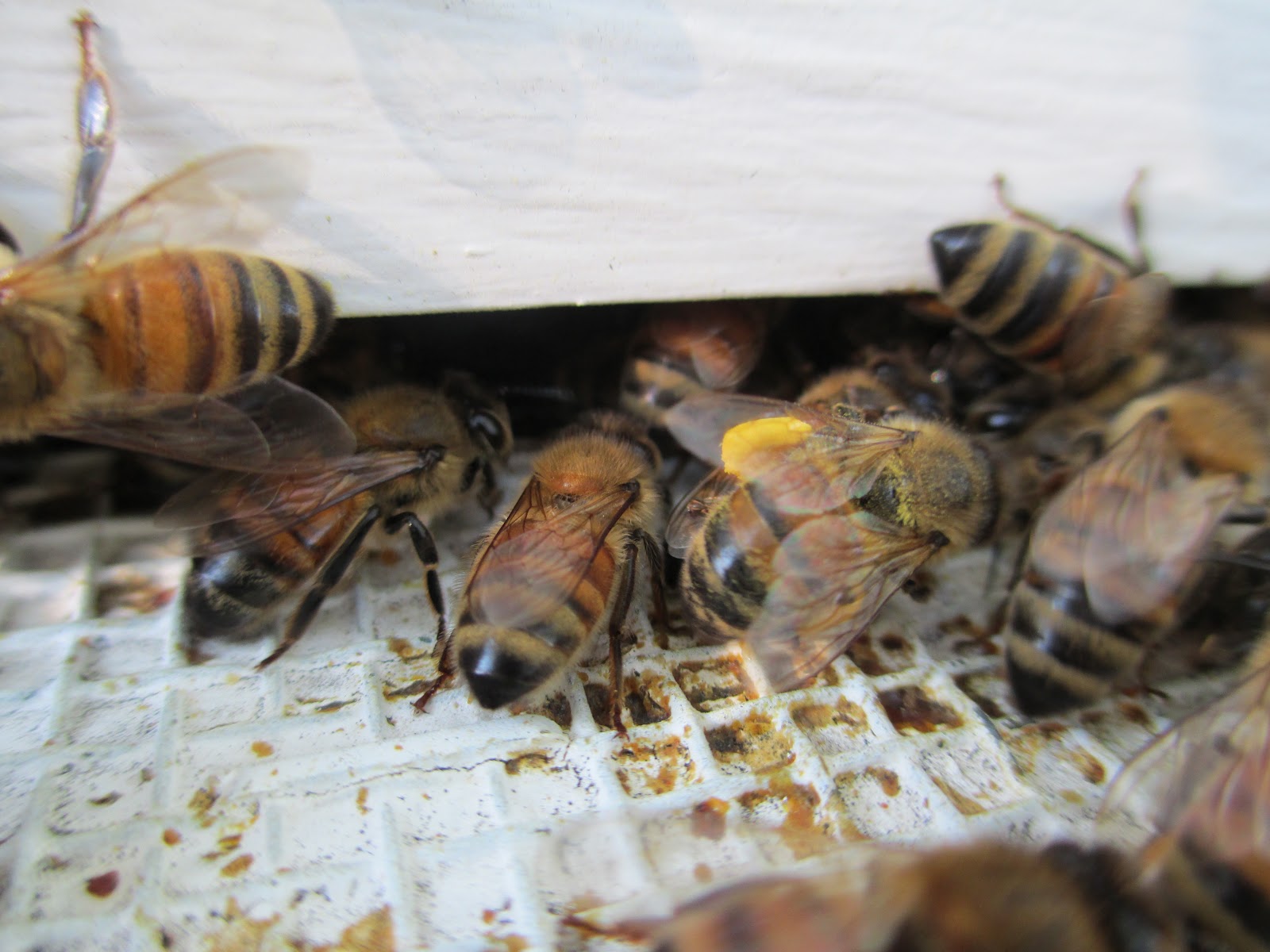
First of all, bee pollen could really be called plant pollen... because that is what it really is.  The bees just do the hard work of collecting it.  As they are wandering from flower to flower to gather nectar (which they turn into honey) they also gather the plant pollen on their hind legs.  The bees create a "bee bread" which is pollen mixed with honey and enzymes, which they feed to their babies.  The pollen provides a great source of protein and carbohydrates, as well as other nutrients important for the bees' growth.   The bees gather this pollen in their little pollen sacs on their legs, and take it back to the hive.
See the bee in the middle with the bright yellow pollen sac? 

 We have a device called a "pollen trap" which sits on the bottom of their hive.  As the bees enter the pollen trap, the sac of pollen is brushed from their legs and falls through a screen below the hive.  But don't worry.... we never take all the pollen from a hive.  The trap can be turned on and off so the bees have plenty of pollen for their own health and vitality.  
Here you see another bee with a small amount of pollen on her leg.
This is what the pollen trap looks like when it is not attached to the hive.  It is basically a series of screens that the bees much walk through to get up into the hive.  As they pass through the screens, the pollen is knocked from their legs and falls to a tray below.  
This next picture shows the pollen trap on the bottom of the hive.  The very bottom wooden part is called the "screened bottom board."  The white part on top of that is the pollen trap.  You can see the little pull out compartment on the hive in the background.  
 
And here you see the compartment being pulled out... full of fresh pollen!   We simply pull out the screen, and drop the pollen in a bucket.  It is ready to be cleaned and bottled.  

Sometimes ants and other little insects find their way in to the pollen, so we have to sift through it and pick it out with tweezers.  It is tedious and time consuming, which is why pollen is worth at least $8 for 7 ounces.  But don't let the price scare you, because if you only take a teaspoon or two a day, it will last a long time.  It's less expensive than most multi-vitamins.


Why do people eat pollen?   Most of our customers eat pollen as a nutritional supplement.  Although all pollens will differ in nutritional components based on the kind of pollen, this gives you a good idea:

Protein 21.2%
Carbohydrates 48.5%
Fiber 14.2%
Fatty Acids 9.9%
Ash 3.5%
Bee pollen is abundant with vitamins, minerals, amino acids, and more.  It is the only food that contains all 22 essential known nutritional elements.  I have read that it is possible to survive on bee pollen alone, as long as you have enough "roughage" to aid digestion.

Another reason people eat bee pollen is to help prevent local pollen related allergies.  By eating just a teaspoon a day, the body gets used to the local pollens.  The pollen we have been harvesting over the past week is full of bright yellow ragweed.  If you have severe ragweed allergies, you will want to take it slow... don't sit down and eat a large spoonful right away, because you may have a severe allergic reaction.  Take just a little bit every day until your body is used to it.

If you are curious about the other benefits of bee pollen, do a simple google search and you will find more information.  Many people believe that pollen can cure almost any ailment.  We aren't going to claim that here... but we have plenty of happy customers that report feeling more energetic, healthier, appetite suppression, and more.  If you'd like to give it a try, here is the listing where you can purchase it in our Etsy shop online.

Please let us know if there are other questions that remain unanswered!  We love your comments!

Sunday, August 26, 2012

Pollen Chasing

-Posted by Isaac

I put the pollen traps back on a few days ago, and took M and M out for the first "pollen run."
The goldenrod is yet to bloom (orange), so I was curious as to what the pollen would look like. As you can see, it's mostly a bright yellow.


Someone in the bee club said this is coming from rag weed.


Pretty stuff. It doesn't taste bad either, although I can't detect the faint sweetness that the goldenrod pollen has.

As part of this pollen run we made a detour to check out a hive. A renegade hive. A friend of a friend had called me about getting some old hives out of his horse pasture.  It turned out there was only one hive and some old hive-body boxes. He said it had been there for years and didn't know or care who's it was. I guess it's mine now.
You can see the previous beekeeper did a tar paper wrap for winter protection. I don't do this. Don't think it helps... but maybe it's just laziness.

As so often happens chasing bees on unknown properties, you find some misadventure. This day, it involved big birds.


I think these things are ostriches. Or maybe some cousin of the ostrich. Either way, pretty scary up close and personal. They showed no fear of the skinny guy and two small kids on their turf.


My conversation with Maizy went like this:
"Daddy, can we pet them!"
"I don't want to go to the hospital today, Maizy."
Pausing...   
"No... I said, can we pet them?"


Mason, thankfully, was a little more tentative.

The summer is winding down, the kids are back in school. (Well, most kids anyway.) Come out and get your honey fix (and honey stix!) at a farmers market before it's too late. Or better yet, come enjoy the Lithopolis Honeyfest on September 8th. It's a great educational and tasty experience.

My sister Molly who lives in Iowa and reads this blog said she thought it sounded like we had a bad honey season. Not true! Sorry I haven't posted about this incredible summer honey that just keeps coming in. I've got two more bee yards to hit this week, and we'll finally have a tally on the summer crop. It's big!
The bees are doing great and it's time to think about getting them ready for winter. We'll keep our fingers crossed for a good goldenrod flow.


Saturday, August 18, 2012

Summer Lovin'...

...happened so fast....

Over the past few weeks I haven't been able to get that song out of my head.  I can't believe Summer is closing in on us.  In previous years, the start of school didn't really affect me since my kids were too young, but this year our oldest son Mason is heading off to a half-day pre-school.  AND he gets to ride the school bus.  (which he is thrilled about).  So we have just a few more days of Summer and then I adjust to my baby leaving the nest every day.  Here are just a few snapshots that capture our last few weeks at Honeyrun Farm.

A visit to the Old Mill Velvet Ice Cream in Utica, OH.

                                 
Feeding corn husks to the horses and cows at Grandma and Grandpas.

Sweet corn!  Our favorite summer treat.

Bridger likes it fresh... no cooking required.


Isaac shows off his latest honey crop.

That's some heavy honey.

Isaac says the hives are "caked out" (full of honey).

"I want a peach!  Daddy, give me a peach!"

Isaac shows Mason and Maizy the wonder of a wax moth larvae.  "Can I put it in the fire, daddy?"  
Lucky for us, the bees know nothing about school starting, and they keep bringing in that sweet summer honey.

-posted by Jayne

Wednesday, August 8, 2012

It's a Sweet Job

-Posted by Isaac

Pun intended.
We've had some high profile people tour the bee farm over the last couple weeks. Two doctors, a lawyer and a medical chemist walked through the honey barn, looked over the hives in the yard, asked insightful questions and silly questions. Yesterday, Mike, the head grocer at Whole Foods Dublin was here to check us out. I put him to work extracting honey.
At my mother's Sunday dinner last week, I was thinking out loud about how such professional people seem impressed with our little mickey-mouse operation. My brother responded with, "I'll bet they're more envious of you than you of them."
True or not, that comment got me thinking. I really do love this job. Even the hot sweaty stinging parts of it. I was pulling honey in a yard last Friday, thinking, entertaining myself with the various reasons I've got a cool job. I jotted ten of them down on the drive home.
So here you go. The top ten reasons this beekeeping life is awesome:

#10 - Beekeepers are characters.
There's good, there's bad, and there's ugly (most, in fact), but everyone I come in contact with in the small world of beekeeping seems opinionated and interesting.

#9 - I don't have to answer to anyone.
Well, my wife, of course. And God sometimes. For the most part though, I'm free to make my own schedule and spend the day as I please. As long as the work gets done I can show up late, start early, take a nap, take a run, take a swim, have a snack, play with kids, etc...   Of course certain times of the year, July and August for example, everything gets crowded out and about all there is to do is work. But I enjoy it.

#8 - You can sample your work as you're doing it.

Honey or pollen, in beekeeping you can continually check the product, making sure it meets the most rigorous quality standards.


#7 - It's a useful job. 
Some jobs turn the wheels of the world and some jobs don't. We all know this. I have in the past, feeling high on myself, described beekeeping as "God's work"  I don't think this is much of a stretch.
Sure, Mr. preacher man, you save souls here and there, but I pollinate whole orchards... I think we all know which is more important in God's eyes.  
  

 #6 - You work in open spaces and you work alone.
That pretty much sums it up. Alas, I'm not always alone. Only on the good days.

#5 - There's something very cowboyish about beekeeping.
I'm not saying this is a good thing, but I think it fits my personality. It kind of goes with the open spaces and working alone thing. I first thought this when I was working with the big commercial migratory operation in Montana. I think maybe Wayne, my boss, even said this a time or two. "We're the last real cowboys..."
We drove the lil' doggies all night long.  We got to watch the sun rise and sun set.
The song is right: Mommas, make your babies be doctors and lawyers and such...


#4 - You don't have to be an ace mechanic
It helps, but unlike farming grain where you have to know how to fix every apparatus under the sun, bee farming deals with a lot of low-tech stuff and hands-on labor. This is good for a dummy like me.
You only need to know a little about pumps, sumps, heaters, spinners, tanks, engines, motors, trailers, saws, nail guns, valves, filters, refractometers, etc.
Which I don't.

#3 - No B.S. hoops to jump through.
When I taught school we had years of certification and recertification. Classes and tests to take. Fingerprinting. Licensing. Professional development days. Collaboration days. Staff meetings. Conferences. Continual improvement evaluations.
Just thinking about all that crap makes my blood run cold.

#2 - Beekeeping is a job where the kids can join in.


 Much like what we see in Amish country where Jayne grew up, the children can see and understand what the parents are doing. Up there, Daddy doesn't drive off in the morning, come back at night and the kids are clueless as to what he's doing all day.
As our kids grow up, I hope they're be able to take part and maybe even one day take over.
So Jayne and I can move to Montana.

#1 - Jayne can always go back to work.
She's the brains behind the operation, so if in the end it all falls apart and comes crashing down, I can simply blame it on her and send her to work. Myself, I'll keep cowboying around with bees.


It's not like she's doing a lot now anyway.